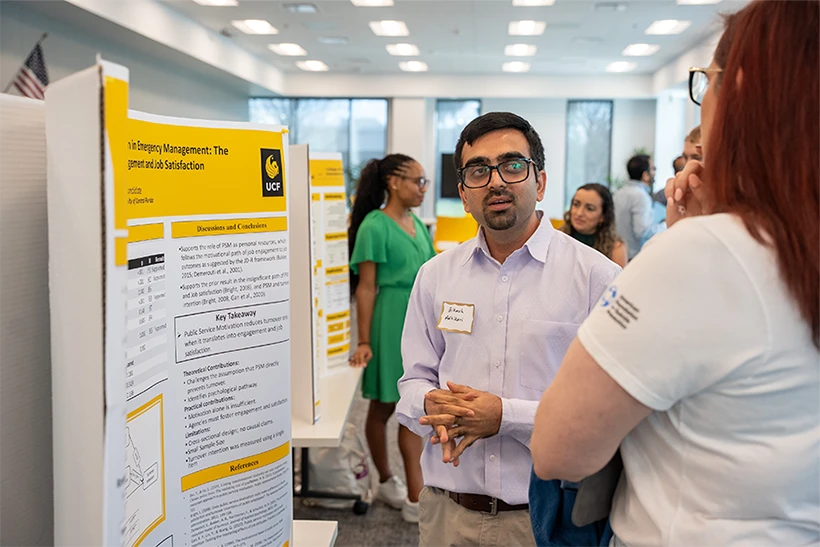
Public Affairs doctoral student Bikash Adhikari presents his research at UCF’s 2026 Public Administration Research Conference. (Photo by Danielle Hendrix)
For Bikash Adhikari, the path to a Ph.D. in public affairs didn’t start in a classroom. It started in the rubble of a devastating earthquake in his home country of Nepal in 2015.
Two years post- disaster, housing reconstruction had barely moved. Working as a civil engineer on post-earthquake recovery projects, Adhikari noticed something that couldn't be fixed with construction plans. The technical capacity was there, but what was missing was harder to see: policy clarity, effective government communication, and the playbook needed to turn recovery plans into reality on the ground.
“I realized I could contribute more from the policy level and governance level rather than being actively engaged in development,” Adhikari says. “That was the time I realized I should pursue my doctorate in this topic.”
That realization brought him to the UCF School of Public Administration’s public affairs doctoral program, where he is now in his fourth year and on track to graduate in Spring 2027. This year, his work has earned him significant national honors.
Adhikari was selected for the 2026 cohort of the Public Administration Theory Network (PATNet) Fellows program — a distinction open to early-career scholars working to advance theoretical frameworks in public administration.
The fellowship comes with a year-long mentorship pairing, seminar programming, and a built-in network of researchers around the world dedicated to public administration issues in different global contexts.
Earlier this semester, Adhikari attended the PATNet annual conference virtually, joining scholars from 22 countries. The discussions centered on how to develop new theories, identify gaps in existing frameworks and strengthen the theoretical foundations of their research.
“Getting to know how the same theories are applied in different countries and different contexts was a great achievement for me,” he says. “There were also sessions on how to improve our writing and how to publish as early-career professionals, from working on data all the way to getting a manuscript out.”
He has since been matched with a faculty mentor whose research aligns closely with his own — the emergency management workforce — and has already submitted manuscripts for feedback. He sees the fellowship as a direct accelerant for his dissertation work.
“I'm expecting this fellowship will help me advance my current theoretical frameworks, as well as help me use more effective theoretical lenses in my future research,” Adhikari says. “The network I'm building through this platform will open a lot of collaborations and opportunities, and it will definitely motivate me to keep contributing to this college and community.”
His original research intent was to study disaster recovery governance, but exposure to organizational theory in his coursework shifted his interests in a new direction. Adhikari’s work now focuses on the people behind emergency management who are asked to perform under extreme stress — and with limited resources and high stakes — every single day. He wants to understand what conditions help sustain the work they do and build professional resilience.
“Emergency management is a high-stress, high-workload zone with limited resources,” he says. “I am currently focusing my research on improving the workplace and making a resilient workforce in emergency management.”
Earlier in the Spring 2026 semester, Adhikari also received the ASPA Wallace O. Keene Conference Scholarship Award from the American Society for Public Administration, which recognizes students whose research focus and publication record demonstrate clear potential in the field. This competitive, merit-based scholarship allowed him to return to the conference for the second consecutive year, where he also had the chance to present his current research.
After graduating, Adhikari plans to pursue an assistant professor or postdoctoral position in the United States. Eventually, he plans to return to Nepal with not just credentials but years of experience in public administration, which will empower to make an impact where it all began.
Grateful for the newfound confidence these experiences have given him already, his advice to others is to always the same: "Just apply anyway,” and trust that the work you're doing matters.
“There are a lot of conferences, a lot of scholarships and opportunities,” he says. “You might not know the capacity of the work you are doing — it might be very meaningful to others in the community. Believe in yourself and do it for the betterment of this field.”