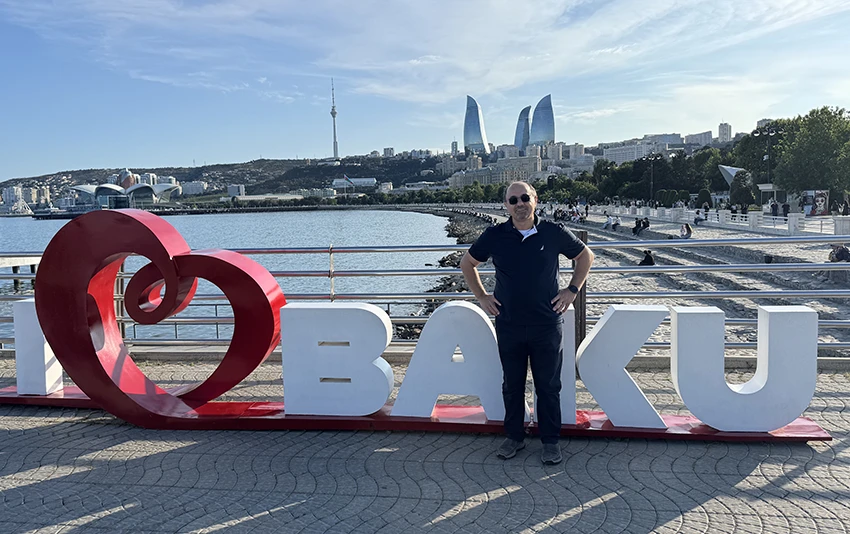
Naim Kapucu traveled to Baku Eurasian University in Baku, Azerbaijan for his second career Fulbright Specialist Award.
Establishing international partnerships and creating opportunities for collaborative research can be a monumental task to undertake. But in Naim Kapucu’s case, it’s the spark that fuels his passion for helping to catalyze impact on a global level.
A Pegasus Professor and associate dean of research in the College of Community Innovation and Education, Kapucu is no stranger to forging relationships with other higher-education institutions abroad. He recently completed his second career Fulbright Specialist Program trip — this time to Baku Eurasian University in Baku, Azerbaijan — where he engaged with university leadership, faculty and students through a variety of activities focused on teaching and research in public administration.
Each year, more than 400 U.S.-based scholars receive Fulbright Specialist Program awards that allow them to visit and engage with host institutions abroad. These short-term visits allow Fulbright Specialists to develop professional relationships, share their own experiences and foster long-term collaboration between institutions.
Kapucu’s time in Baku was largely focused on strengthening research capacity and laying the groundwork for future joint initiatives between U.S. and Azerbaijani institutions.
“I had the chance to meet with colleagues from other universities, as well as government officials, which enriched the exchange and opened avenues for future collaboration,” he says. “It was also particularly meaningful to connect with Fulbright visitors who had previously been at UCF, as well as UCF graduates who are now contributing as faculty in the country.”
In meetings with university leadership, Kapucu and his colleagues identified key opportunities for joint research, along with student and faculty exchanges designed to facilitate mobility and collaborative learning experiences. They even discussed the longer-term potential of developing dual-degree programs in partnership between institutions.
“The U.S. Embassy in Baku was extremely supportive throughout the visit and has expressed interest in helping connect government officials with UCF and Florida-based initiatives,” Kapucu says. “These efforts could lead to meaningful collaborations in areas such as tourism development, scientific research, and research park models.”
Kapucu’s expertise in public administration also proved invaluable through his contributions to meetings, presentations, lectures and collaborative discussions. That included advising on grant development and sharing best practices in governance, crisis preparedness and organizational resilience. He also conducted research seminars for faculty members and graduate students, as well as a workshop on publishing in high-impact journals — all with the goal of enhancing scholarly output.
And as the keynote presenter for Baku Eurasian University’s “Democracy, Governance, and Global Perspectives” event — dedicated to the United States’ 250th anniversary — Kapucu drew on his experience as a global scholar in America to highlight the role of higher education, democratic institutions and international exchange in fostering innovation, public service and global collaboration.
“Their students were highly engaged, inquisitive and asked thoughtful questions that reflected a strong awareness of current global trends, from artificial intelligence to the evolving role of social media in society and governance,” he says. “In addition, the university’s strong commitment to international engagement is evident through its partnerships and connections with other institutions around the world.”
Although the trip is now complete, the groundwork has just been laid for strengthening institutional ties and bolstering a more robust academic network. Kapucu is optimistic about pathways for joint research, academic exchanges, and curriculum development efforts that could expand UCF’s global research footprint while advancing solutions to shared challenges in governance, public policy and crisis management.
“My focus moving forward is to maintain active communication with our partners, align opportunities with institutional priorities, and gradually formalize these collaborations into structured programs that create lasting impact for both universities,” he says.