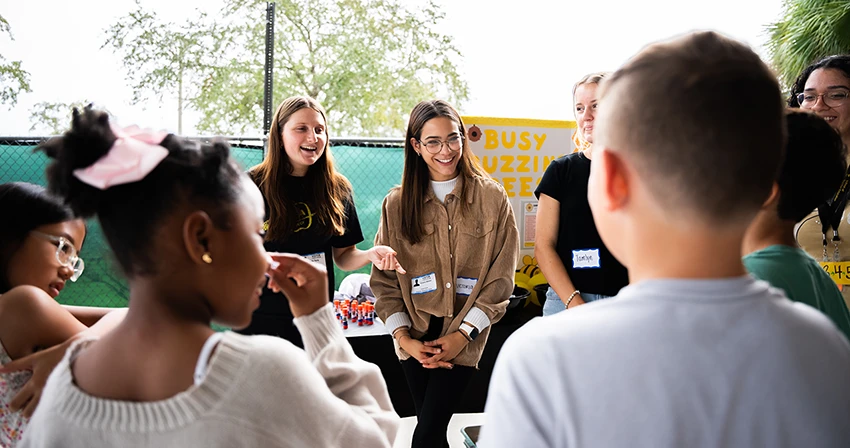
Boots on the Ground gives UCF education majors a unique chance to gain classroom experience, develop teaching skills and explore their future career path.
Becoming a teacher is often described as a calling, and many students arrive on college campuses certain they want to make a difference in young learners’ lives. But liking the idea of teaching and understanding the day-to-day reality of the profession are two very different things.
That’s where Boots on the Ground comes in.
Launched nearly 14 years ago through the College of Community Innovation and Education’s School of Teacher Education, Boots on the Ground is a program that connects UCF education majors with real classrooms from their first semester. The goal is simple but powerful: Give aspiring teachers meaningful, hands-on experience early in their academic journey, and long before internships begin.
Constance Goodman and Lee-Anne Trimble Spalding — associate lecturer and senior lecturer, respectively — in the School of Teacher Education, first introduced Boots on the Ground to UCF and continue to lead it today. By placing freshmen in classrooms immediately, the program helps students confirm — or even reconsider — their career choice early.
“If you wait until junior year to step in front of a classroom, it can be overwhelming,” Goodman says. “That’s a big reason students struggle and might change majors. Through Boots on the Ground, students start volunteering in freshman year. Then, by the time they get to their first internship, they’re confident to take over a classroom.”
The program was born from a conversation with a local school leader.
“In a meeting with John McHale, who was principal of Deerwood Elementary School at the time, we were talking about how we could partner and do two things: Prepare our teacher candidates early in their studies, and help the classrooms’ teachers by providing more boots on the ground in schools,” Goodman says. “We thought, ‘Who better to help support the classroom than UCF’s aspiring educators?’”
What started as a partnership with one school has since expanded to nine schools in total, primarily in Orange County Public Schools. Today, nearly 200 UCF students volunteer in the program each semester. Teachers often opt in to host volunteers, and principals actively promote the partnership.
“School principals value the program so much that they come to UCF and share information about their schools to encourage the students to select their site,” Goodman says. “It’s a very streamlined process. Students attend an orientation at UCF and another at their assigned school, and we take care of the logistics so they can focus on learning.”
Rather than simply observing, participants complete at least 15 hours of service in active roles such as working one-on-one with students on reading activities, assisting small groups, supporting classroom management and even attending meetings like IEP conferences.
For many first-year students, the experience is eye-opening. Kaliya Crichfield, a freshman in the bachelor of science in elementary education degree program, says teaching felt different from what she expected.
“In the classroom, you have to do a lot of multitasking,” Crichfield says. “You’re watching students to make sure they’re safe, helping teach the lesson, managing disruptions and following a schedule all at once. I didn’t realize how complex classroom management could be.”
Nevertheless, she says the early exposure has strengthened her commitment to teaching.
“When it’s time for my internship, I’ll be a lot more at ease because I won’t be going in blind,” Crichfield says. “Helping these students in the classroom was a great experience. Boots on the Ground has made me feel more confident.”
Layla Brownell, another freshman in the same program, entered college knowing she wanted to work with children but was unsure of which age group would be the right fit. Through Boots on the Ground, she explored different settings before realizing her passion for teaching younger students.
“Boots on the Ground solidified my choice to pursue elementary education,” Brownell says. “It gives you a clear picture of whether this career is right for you.”
Over time, Boots on the Ground has evolved into something larger than originally envisioned — a pipeline for future educators. Some students continue volunteering beyond their required hours, while others complete multiple internships at their placement schools and ultimately accept teaching positions there. In some cases, principals hire participants as tutors even before graduation.
Esther Kusner ’07 ’13MEd is one example of the program’s lasting impact. A graduate of both the social science education track of the secondary education bachelor’s degree program and the master’s in educational leadership program, she now serves as assistant principal at Discovery Middle School, where she helps coordinate Boots on the Ground. For her, the program’s impact is clear.
“It’s inspiring to watch the volunteers make a meaningful difference in our classrooms,” Kusner says. “Teachers value the small-group support, and students build strong rapport with the volunteers. It contributes to a positive learning environment.”
She says she appreciates Boots on the Ground not just as a tutoring initiative but as a bridge between the university and K-12 schools.
“I see how valuable it is to have motivated, service-minded college students working directly with our kids,” Kusner says. “They bring fresh energy, additional academic support and personal role modeling that students genuinely respond to.”
Over the years, school administrators like Kusner have continued to champion Boots on the Ground and help expand it by bringing it to new campuses. That sustained support is a clear sign of the program’s success.
“It’s just been a win-win for us,” Goodman says. “Our candidates get preparation and connect theory to practice, and the schools get help. It’s an amazing partnership.”